
Read Our Latest Blog Posts:
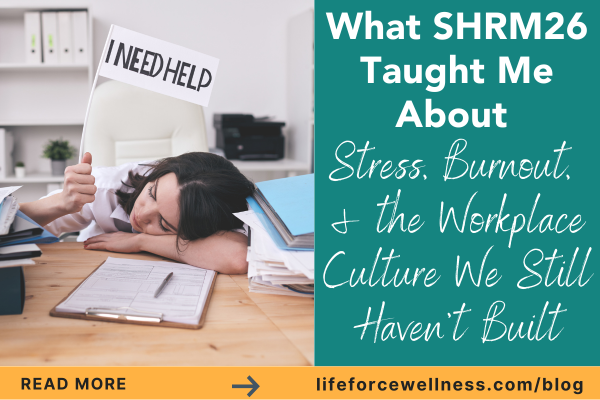
What SHRM26 Taught Me About Stress, Burnout, and the Workplace Culture We Still Haven't Built
Last week, I had the incredible opportunity to attend and speak at the SHRM National Conference in Orlando, Florida.
Whenever I attend a conference, I try to pay attention not only to what is being taught on stage, but also to what people are talking about in the hallways, at networking events, and between sessions. Often, those conversations tell you just as much about what's happening in workplaces as the presentations themselves. One thing became clear almost immediately.
People are still struggling with stress.
Not just employees.
Leaders.
Managers.
HR professionals.
Executives.
Everyone.
In fact, some of the most well-attended sessions at the conference focused on stress management, burnout, psychological safety, workplace culture, and employee well-being. My own presentation, Don't Push My Buttons: How Leaders Trigger Workplace Stress, received incredible engagement and feedback, which reinforced something I've suspected for a long time:
We're talking about burnout more than ever, but many organizations are still missing the practical skills needed to prevent it.
The good news is that people want to learn. They want healthier workplaces. They want psychologically safe cultures. They want employees who feel supported without sacrificing accountability or performance.
What struck me most was how hungry leaders are for tools.
Not theories.
Not buzzwords.
Tools.
That's what led to one of the most fascinating conversations I had during the conference.
A gentleman approached me after one of my sessions and shared an experience from a leadership development program he had attended years ago.
The facilitator walked into the room visibly frustrated. Without much explanation, he slammed papers down in front of the participants and barked out instructions. The directions were vague and confusing. Nobody was entirely sure what they were supposed to do, but the group worked together and tried their best to complete the assignment.
About an hour later, the facilitator returned.
He walked around the room reviewing their work.
"Nope."
"Wrong."
"Not even close."
Then he provided a bit more clarification and left again abruptly.
The participants looked at each other, confused and frustrated.
When the gentleman recounted the story, he laughed and admitted his first reaction was, "Forget this. I'm done."
But then something strange happened.
Instead of disengaging, he became more determined. He wanted to get it right. He wanted the facilitator's approval. He wanted to prove himself. And he noticed something even more interesting: everyone else in the room seemed to feel the same way.
They weren't pulling away from the stressful situation. They were moving toward it.
As he told me the story, he asked a question that immediately caught my attention.
"Why did I care so much about making that guy happy?"
The answer lies in something we don't talk about nearly enough.
Most people have heard of fight, flight, and freeze.
When we perceive a threat, our nervous system activates and prepares us to protect ourselves. Some people confront the threat. Some avoid it. Some become paralyzed by it. But there is a fourth stress response that receives far less attention. It's called fawn.
The fawn response occurs when we attempt to reduce danger by pleasing the source of the stress. Instead of fighting, fleeing, or freezing, we adapt. We accommodate. We seek approval.
In simple terms, the nervous system begins to believe:
"If I can make them happy, they'll leave me alone."
"If I do enough, I won't be criticized."
"If I keep producing, I won't be rejected."
"If I exceed expectations, I won't become a target."
The more I thought about that conversation, the more I realized how often this shows up in the workplace.
A leader praises employees who never say no.
An employee volunteers for every project.
Someone answers emails at midnight.
A high performer continuously takes on more work despite being overwhelmed.
On the surface, it looks like engagement.
It looks like dedication.
It looks like commitment.
But sometimes it's fear.
Sometimes it's a stress response.
Sometimes employees aren't saying yes because they want to. They're saying yes because they're afraid of what happens if they don't. That's where leaders need to be careful. When people are operating from a fawn response, we can easily mistake compliance for commitment. We can mistake people-pleasing for engagement. We can mistake survival behaviors for healthy performance.
Over time, that pattern becomes one of the fastest routes to burnout. The employee keeps saying yes. The leader keeps asking. Nobody has the conversation. And eventually something breaks.
As I reflected on the conversations at SHRM, I found myself wondering if this may be one of the next major workplace conversations. We've spent years talking about burnout. We've spent years talking about psychological safety.
Perhaps the next step is helping leaders understand how stress responses influence workplace behavior and how those responses can unintentionally be reinforced by organizational culture.
If you suspect your employees may be people-pleasing out of fear rather than engaging out of commitment, here are three simple places to start:
1. Normalize Healthy Boundaries
Make it safe for employees to say, "I don't have capacity right now."
If every request requires an immediate yes, people will stop being honest about their workload.
2. Reward Transparency, Not Heroics
Be careful about celebrating employees solely because they work longer hours, skip vacations, or continuously take on more work. Instead, recognize thoughtful prioritization, communication, and sustainable performance.
3. Ask Better Questions
Rather than asking, "Can you get this done?" try asking, "What would need to come off your plate to make this possible?"
One question assumes capacity. The other creates psychological safety.
As I left SHRM26, I felt encouraged. Not because we've solved burnout or because we've mastered workplace well-being. But because so many leaders, HR professionals, and organizations are actively trying to learn.
They're asking better questions. They're looking for practical tools. And they're recognizing that workplace culture isn't just about productivity.
It's about people.
And that conversation is one worth continuing.
Ready to Start the Conversation?
Creating a psychologically safe workplace doesn't happen by accident. It requires leaders who are willing to ask better questions, recognize the impact of stress on behavior, and intentionally build cultures where employees feel safe speaking up, setting boundaries, and asking for help.
If this article resonated with you, or if you're seeing signs of burnout, people-pleasing, disengagement, or chronic stress within your team, I'd love to help.
Through leadership training, keynote presentations, workshops, webinars, and coaching, I work with organizations across the country to help leaders create healthier, more productive workplace cultures.
Feel free to send me a message on LinkedIn or schedule a complimentary conversation here: https://calendly.com/lfwellness/30min.
Together, we can create workplaces where employees don't just survive; they thrive.

Contact
© Copyright 2023. Life Force Wellness. LLC.. All rights reserved.