
Read Our Latest Blog Posts:
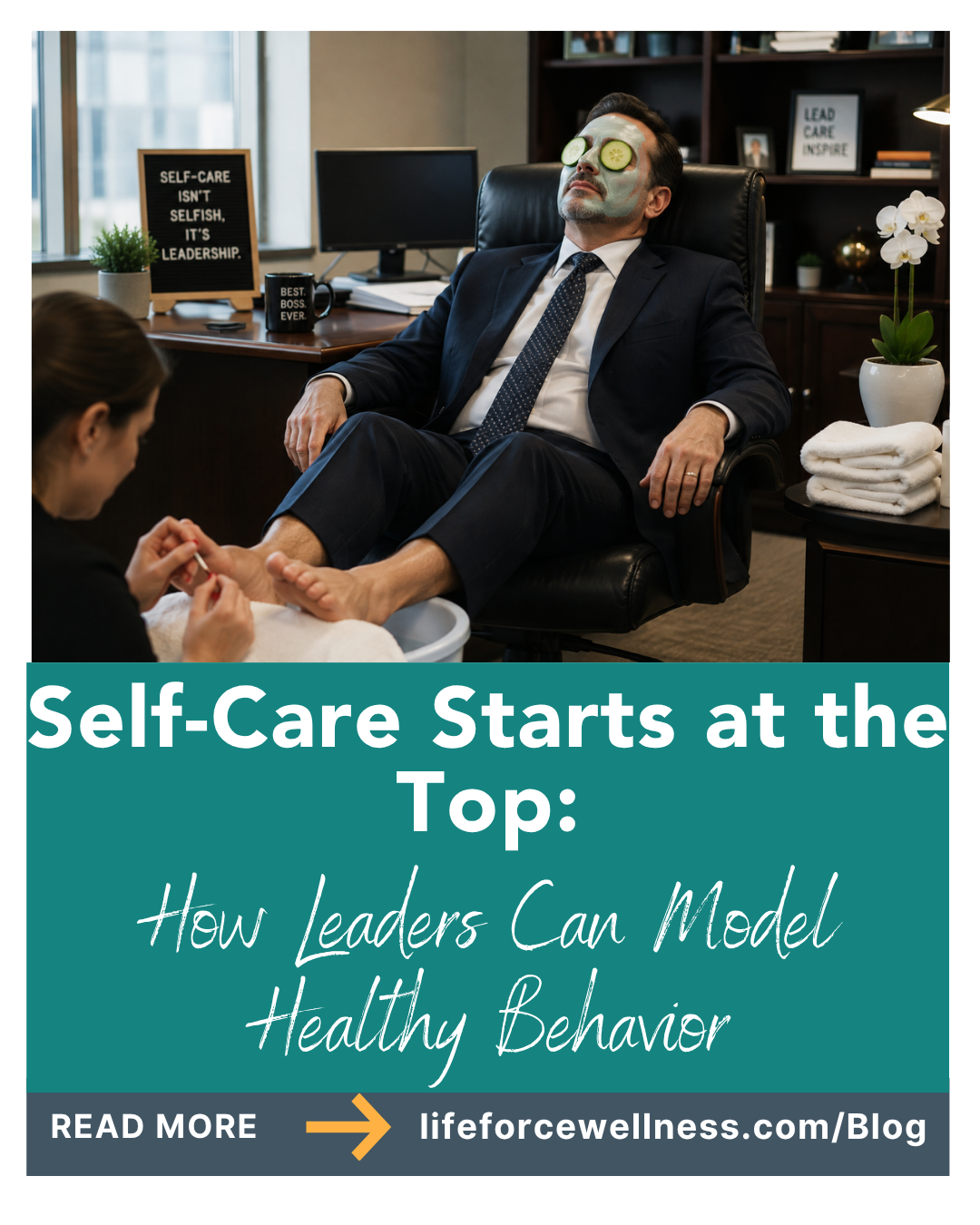
Self-Care Starts at the Top: How Leaders Can Model Healthy Behavior
If the CEO never takes a day off, answers emails at midnight, works through every vacation, and proudly announces that they haven’t taken a sick day in 15 years, what message does that send to everyone else?
Employees may technically have paid time off and be told to prioritize their well-being. They may even receive emails encouraging them to practice self-care, but the behavior at the top communicates something very different:
The people who are truly committed are always available.
Then there is the opposite extreme.
Leadership appears to spend every Friday afternoon on the golf course while employees are overloaded, understaffed, and struggling to keep up. Leaders enjoy flexibility, but employees are questioned every time they need to leave early, attend an appointment, or take a day off.
That doesn’t create a culture of self-care either; it creates resentment.
Healthy leadership is not about becoming a workplace martyr. It is also not about enjoying privileges that no one else can access.
It is about creating a culture where people can take the time they genuinely need, remain accountable for their responsibilities, and return ready to perform, without guilt, resentment, or abuse of the system.
Employees Watch What Leaders Do
Leaders influence culture through more than policies and motivational messages. Employees watch what their leaders actually do and notice whether the manager who encourages everyone to take a vacation continues emailing the team throughout their own.
They notice when a leader says, “Family comes first,” but becomes visibly irritated when someone needs to attend a child’s school event.
They notice when taking a mental health day is officially allowed but then hear gossip and whispers about how it is interpreted as a lack of dedication.
They also notice that flexibility seems reserved for executives. At the same time, everyone else is expected to stay glued to a desk, production line, jobsite, or computer while hearing, “I put in my time.”
A policy may give employees permission on paper, but leadership behavior gives them permission in practice.
Stop Making Exhaustion Look Like Leadership
We have spent years glorifying leaders who are always working, promoting hustle culture. These leaders arrive first, leave last, answer every email immediately and they never completely disconnect.
That may look like dedication, but it also communicates that exhaustion is part of the price of success.
When leaders consistently sacrifice sleep, recovery, relationships, and personal time, employees begin to believe they must do the same to be respected, promoted, or seen as committed.
Eventually, overwork becomes part of the culture. I have seen this firsthand. I know a young father who became more intentional about leaving work on time after he and his wife welcomed a child. His work was still getting done. He continued meeting his deadlines, but he managed his workday more carefully because he wanted to be home with his family.
One day, his manager called him into the office and told him that he no longer seemed as dedicated because he was leaving on time. The manager explained that he had sacrificed time with his own family to advance professionally and told this young father that he needed to decide whether he wanted to be a family man or get promoted.
The employee knew his manager had an estranged relationship with his own children, and he didn't want that to be his future.
He chose his family.
Four weeks later, he left the organization for an employer that valued both his work and his life outside of it.
People who compete over who is busiest hesitate to use their time off. They work while sick, infecting the rest of the office, and remain available long after the workday ends. They do this not because every situation is truly urgent, but because being unavailable feels risky to their professional growth.
Leaders do not need to prove their commitment by neglecting themselves. Self-care helps maintain the physical energy, emotional regulation, mental clarity, and decision-making capacity required to lead well, and it should not be seen as a lack of ambition.
Model Recovery and Let People See It
Leaders sometimes practice healthy habits privately while unintentionally projecting constant availability publicly. They will take a vacation but keep responding to every email or leave early for an appointment but tell everyone they will remain available by phone.
As a leader, you might encourage your team to take lunch while you eat at your desk during every break. If employees never see you disconnect, they may assume they are not allowed to disconnect either.
Healthy role modeling can sound like:
“I’m taking Friday off, and I won’t be checking email. Sarah has what she needs while I’m away, and I’ll follow up when I return on Monday.”
Or:
“I have a medical appointment this afternoon, so I’ll be unavailable after 3:00. If anything urgent comes up, here is who you should contact.”
Or even:
“I was planning to work late tonight, but this can wait until tomorrow. Let’s pick it back up when we’re rested.”
Leaders do not need to share every personal detail. They simply need to demonstrate that using time off, setting boundaries, and caring for personal needs are normal parts of working responsibly.
Self-Care Requires More Than Permission
Telling employees to take time off doesn't help when the workload makes it nearly impossible. If someone returns from vacation to 600 emails, missed deadlines, frustrated clients, and twice as much work, the time away may not feel restorative or worth taking.
If the rest of the team must absorb an unreasonable workload every time someone is absent, employees may feel guilty for leaving their coworkers behind. That is why organizations need systems that make recovery possible.
That may include:
Cross-training employees so one person is not responsible for everything
Creating clear coverage plans
Establishing realistic deadlines
Identifying what can wait until someone returns
Defining what is truly urgent
Reducing unnecessary after-hours communication
Encouraging employees to completely disconnect during scheduled time off
Making sure workloads are reasonable before and after an absence
Self-care cannot depend entirely on an employee’s willingness to set a boundary inside a system that repeatedly punishes them for doing it. Leaders must help create the conditions that make healthy choices realistic.
What About People Who Abuse the System?
This is often where leaders get stuck.
They want to offer flexibility, encourage time off, and support employee well-being, but they are worried someone will take advantage of it. That concern is not completely unreasonable. Any workplace policy can be misused. However, the possibility that one person may abuse flexibility is not a good reason to create a culture where everyone feels guilty for having legitimate needs.
The solution is not to eliminate flexibility but to pair flexibility with clear expectations and consistent accountability.
Employees should understand:
What results they are responsible for producing
What deadlines and standards must be met
How much notice is expected when possible
How coverage should be arranged
How communication will be handled during an absence
Which responsibilities cannot simply be abandoned
What happens when a pattern begins affecting the team or the work
When expectations are clear, leaders can address misuse as a performance or accountability issue. You do not need to create restrictive rules for everyone because one employee failed to meet the standard.
Trust is not the absence of accountability. Accountability is what makes flexibility sustainable.
Measure Contribution, Not Performative Busyness
One of the most effective ways to reduce guilt around self-care is to stop confusing visibility with productivity. The person who sends emails at 10:30 p.m. is not automatically more committed than the person who completes high-quality work during normal hours.
The employee who never uses PTO is not necessarily your highest performer, and the leader who is constantly busy running around and attending meetings may not be producing the results that matter most.
Healthy workplace cultures focus on:
Clear outcomes
Quality work
Reliable follow-through
Honest communication
Appropriate responsiveness
Collaboration
Accountability
When employees know how their performance will be evaluated, they are less likely to believe they must constantly prove their value by looking busy, staying late, or remaining available during personal time.
Make Self-Care Fair, Even When It Cannot Look the Same.
Flexibility will not look identical in every role.
A corporate employee may be able to work from home for part of the day. Someone operating machinery, caring for patients, running a production line, or working directly with customers may need to be physically present.
Fairness does not always mean giving everyone the exact same arrangement. It means ensuring every employee has a realistic way to support their well-being within the requirements of their role.
For one employee, that may mean remote work; for another, it may mean predictable scheduling, uninterrupted breaks, shift coverage, adequate staffing, advance notice of overtime, or the ability to attend an appointment without being treated like they committed an offense.
Leaders should ask:
“What does meaningful flexibility and recovery look like for this job?”
That is a much better question than copying a benefit designed for office employees and assuming it supports everyone equally.
Create a Culture Where People Can Tell the Truth
Employees should be able to say:
“I am at capacity.”
“I need help prioritizing.”
“I need to use a sick day.”
“I have an appointment.”
“I need time to recover.”
“I can take this on, but something else will need to move.”
Those statements should not automatically be interpreted as laziness, weakness, or a lack of commitment as they are often signs of awareness, communication, and responsible self-management.
Of course, employees are still expected to communicate, meet reasonable standards, and contribute to the team. Supporting self-care does not mean eliminating expectations. It means creating an environment where people can be honest about what they need without fearing that honesty will be used against them.
Leaders Set the Tone
Employees do not need leaders who work themselves into the ground.
They also do not need leaders who preach wellness from the golf course while everyone else carries the workload.
They need leaders who model a healthier middle ground:
Take the time you need. Communicate clearly. Prepare appropriately. Meet the standard. Support the team. Return ready to contribute.
That is not indulgence; it is responsible leadership.
When leaders model healthy boundaries, create workable systems, and hold people accountable for outcomes rather than appearances, self-care becomes part of sustainable performance, not an escape from responsibility.
Because the goal is not to help people do less, it is to help them remain well enough to consistently do their best work.
Continue the Self-Care September Conversation
Join me for the next leadership session in our Self-Care September webinar series:
Your Team Is Watching: How Leaders Set the Tone for Self-Care
We’ll explore how leaders can model healthy boundaries, create greater psychological safety, support employees in taking the time they need, and maintain the accountability required for strong performance.
Register Here – https://www.eventbrite.com/e/1997641335008?aff=oddtdtcreator
Life Force Wellness also offers practical workplace wellness presentations, leadership development programs, and conference sessions that help organizations create healthier people, stronger teams, and better performance.

Contact
© Copyright 2023. Life Force Wellness. LLC.. All rights reserved.