Read Our Latest Blog Posts:
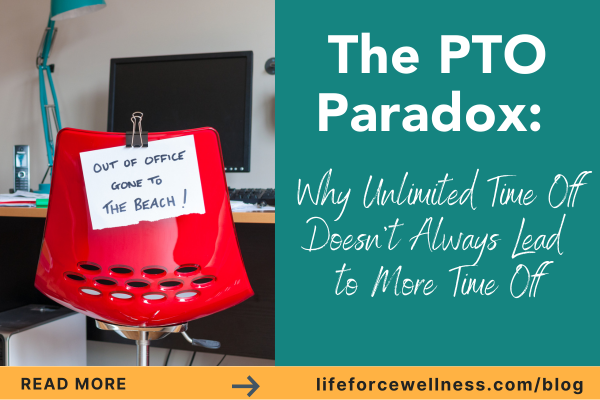
The PTO Paradox: Why Unlimited Time Off Doesn't Always Lead to More Time Off
It is summer, and many people in the USA are headed out of the office – many of you already are, I know, because I got your out-of-office reply, and that is great. Summer means vacation, the kids are out of school, the weather is nice, and we all feel like we could use a break.
One reason I left corporate to work for myself was that I didn’t like the idea of having to ask permission to take a day off. I hated the January scramble to be the first one to get the request for premium vacation days because it was done on a first-come, first-served basis. The idea that as a grown woman with a family I had to call and ask permission to not come into work because my child was sick, never mind when I was sick, just never sat well with me.
Back then, if someone had asked me what the perfect employee benefit looked like, I probably would have said unlimited paid time off. Think about it: no more counting vacation days or deciding whether you should save a few days for the holidays or use them for your child's spring break. No more feeling like you have to ration your time away from work or rush to book the trip because you were awaiting approval. It sounds like the ultimate sign that an organization trusts its people.
But then something interesting happened.
Organizations began implementing unlimited PTO policies, and researchers started tracking what employees actually did with them. You would expect people to take more vacation, right? Surprisingly, many didn't. In fact, the Society for Human Resource Management (SHRM) has reported that employees with unlimited PTO average only about sixteen days off each year, compared to roughly fourteen days for employees with traditional PTO plans. Two extra days certainly isn't the dramatic increase many leaders expected.
That statistic made me stop and think.
If employees have unlimited vacation available, why aren't they taking it?
The answer has very little to do with PTO policies and almost everything to do with workplace culture.
As I work with leaders across the country, I hear the same concerns over and over again. Employees tell me they technically have the flexibility to take time off, but they don't want to leave their coworkers short-staffed. Others worry about returning to an overflowing inbox or missing an important opportunity. Some quietly wonder whether taking a week off will make them look less committed than the coworker who proudly says they haven't taken a vacation in two years.
No one may ever say, "Don't take your PTO." But culture has a funny way of communicating messages that policies never do.
When employees watch their manager answer emails from the beach, they learn that vacation isn't really vacation. When promotions consistently go to the people who are always available, they begin to believe visibility matters more than results. When leaders praise someone for "never taking a sick day," they unintentionally send the message that rest is something to be ashamed of instead of something to value.
Eventually, employees begin asking themselves a different question. It isn't, "Can I take time off?" It's, "Will people think less of me if I do?"
That's a dangerous place for an organization to be.
Gallup has consistently found that burned-out employees are significantly more likely to be disengaged at work, actively searching for another job, and calling off unexpectedly. Burnout doesn't make people more productive; it makes it harder for them to bring their best thinking, creativity, and energy to work each day. Offering generous benefits doesn't solve burnout if employees don't feel psychologically safe enough to use them.
That's why I believe leaders have a responsibility that extends far beyond approving vacation requests. They have to model the behavior they hope to see.
I've worked with organizations where leaders proudly announce that employees should "take all the time they need." Yet they answer emails from the airport, join conference calls from the beach, and respond to text messages during family dinners. They genuinely mean well, but their actions tell a different story.
Culture isn't built by what's written in the handbook. Culture is built by what leaders consistently demonstrate.
If you want employees to unplug, you have to unplug.
If you want people to prioritize their well-being, they need to see you prioritize yours.
If you want employees to believe they're trusted, they need to know the business can function without them for a few days.
One of the most powerful things a leader can say to an employee before they leave on vacation is, "Go enjoy yourself. We've got everything covered."
Those six words communicate trust, support, and permission all at once.
Employees have a responsibility in this conversation too.
If your organization offers paid time off, whether it's two weeks or unlimited, you don't have to justify every day you take. Not every vacation requires plane tickets or an itinerary. Sometimes what your mind and body need most is a random Tuesday at home. Sleep in a little later, read the book that's been sitting on your nightstand, go for a hike, have lunch with a friend, or sit on the porch with a cup of coffee and no agenda.
Recovery doesn't always look like a tropical vacation on Instagram.
Sometimes it simply looks like breathing.
One of the biggest misconceptions we've created in our culture is that rest has to be earned. We tell ourselves we'll slow down after the project is finished, after busy season ends, after the kids go back to school, after one more deadline.
But the truth is, there will always be another project, another deadline, and another busy season waiting around the corner. Rest isn't the reward for surviving burnout; rest is one of the ways we prevent it.
Professional athletes understand this. They schedule recovery days because they know muscles don't grow while they're lifting weights; they grow while they're recovering. High-performing organizations would be wise to adopt the same philosophy. People don't perform at their best because they work every possible hour. They perform at their best because they have the physical, mental, and emotional capacity to bring their whole selves to work.
That's why I believe the greatest benefit a company can offer isn't unlimited PTO.
It's a culture where employees feel comfortable using it.
Because at the end of the day, the goal isn't simply to create employees who work hard.
It's to create people who can work well, for years to come.
Now What
Creating a culture where employees feel comfortable taking time off doesn't happen by accident. It requires intentional leadership, clear expectations, and a workplace where trust is built through actions, not just policies. Unlimited PTO alone won't prevent burnout. Leaders who model healthy boundaries, encourage recovery, and recognize results over constant availability create teams that are more engaged, more resilient, and ultimately more productive.
At Life Force Wellness, this is exactly the work I love to do. Through leadership development programs, keynote presentations, and employee wellness workshops, I help organizations create cultures where people can perform at their best without sacrificing their well-being. Whether we're teaching leaders how to recognize the early signs of burnout, building psychologically safe workplaces, or helping employees develop practical strategies to disconnect, recharge, and build resilience, the goal is always the same: creating a workplace where people don't just survive, they thrive.
If you're ready to build a healthier workplace culture where high performance and well-being go hand in hand, I'd love to start the conversation.
Book a call today - https://calendly.com/lfwellness/

Contact
© Copyright 2023. Life Force Wellness. LLC.. All rights reserved.