
Read Our Latest Blog Posts:
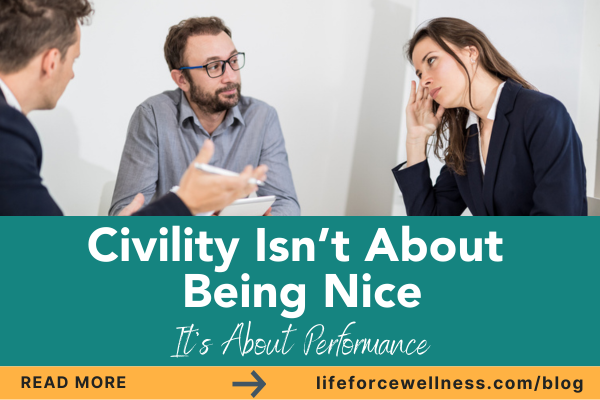
Civility Isn’t About Being Nice, It’s About Performance
We’ve all seen it before.
A tense meeting. A sharp email. A moment where someone gets cut off, dismissed, or overlooked. And while it may seem small in the moment, those interactions add up.
Not just culturally, but operationally. Because when incivility shows up in the workplace, people don’t perform. They protect.
The Hidden Shift: From Performance to Protection
One of the biggest misconceptions about workplace behavior is that people disengage because they don’t care. In reality, it’s often the opposite. They care, but they don’t feel safe.
When employees experience behaviors like interruption, dismissiveness, lack of recognition, or inconsistent feedback, the brain interprets that as a threat. And when that happens, people naturally shift into self-protection mode.
You start to see it in subtle ways:
Holding back ideas
Avoiding ownership
Over-documenting conversations
Saying less in meetings
People may seem like they are being difficult on the outside when in reality they are trying to navigate risk.
Why This Matters More Than Ever
According to research from Society for Human Resource Management, workplace incivility has a measurable impact on performance:
Employees reduce effort
Productivity declines
Turnover increases
Engagement drops
This isn’t just a “culture issue.” It’s a performance issue.
The Leadership Shift
The organizations that are getting this right aren’t just focusing on policies or programs. They’re focusing on behavior.
More specifically:
How feedback is delivered
How conflict is handled
How leaders show up in everyday interactions
Because culture isn’t built in big moments; It’s built in micro-moments.
So What Actually Works?
In my work with organizations, I focus on three core areas:
1. Understanding What Triggers Friction

Not all conflict is about the issue at hand. Often, it’s about how the brain is interpreting the interaction, whether as a threat or a sign of safety.
2. Improving How Feedback Is Delivered
Most people don’t avoid feedback because they don’t care, they avoid it because they don’t know how to give it clearly and constructively.
3. Repairing When Things Go Sideways
Because they will.
The goal isn’t perfection. It’s how quickly and effectively teams can repair and rebuild trust.
The Real Question
Every interaction in your organization is doing one of two things:
Creating safety… or creating threat.
And over time, those interactions shape how people show up, communicate, and perform.
Join the Conversation
This is exactly what I’ll be diving deeper into this week with Erie SHRM, and later this year as a breakout session at the SHRM Annual Conference & Expo in Orlando Florida.
If you’re thinking about how this shows up in your organization or how to equip your leaders with better tools, I’d love to connect.
Because at the end of the day…
Civility isn’t about being nice.
It’s about creating an environment where people can do their best work.

Contact
© Copyright 2023. Life Force Wellness. LLC.. All rights reserved.