
Read Our Latest Blog Posts:
Finding the Sweet Spot: Balancing Psychological Safety and Accountability
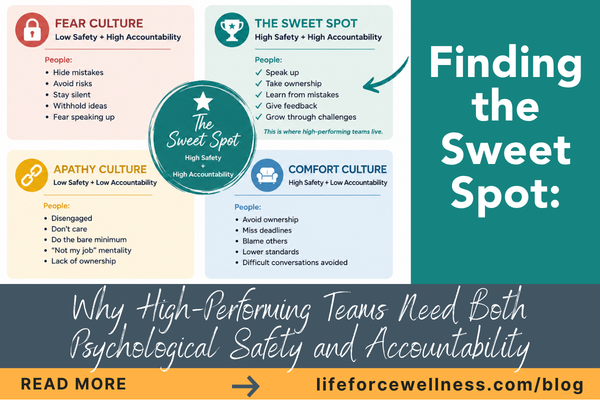
During my recent From Hot Mess to High Performance presentation at the PHRA Annual Conference, one image generated more conversation than almost anything else I shared.
It was an accountability matrix showing four types of workplace cultures:
Apathy Culture
Fear Culture
Comfort Culture
The Sweet Spot
The matrix is built around two things every workplace needs:
Psychological safety—the trust, respect, and openness that allow people to speak honestly.
Accountability—the clear expectations, ownership, and follow-through that ensure the work gets done.
Organizations often believe they must choose between the two. They can create a “tough” culture where people are held accountable, but employees are afraid to make mistakes or speak up. Or they can create a “nice” culture where people feel supported, but difficult conversations are avoided and standards quietly begin to slip. High-performing teams choose neither.
They find the sweet spot.
I Know What a Fear Culture Feels Like
When I worked in the oil and gas industry, I had a boss who demanded that I call him “Sir.” Not because it was a formal workplace requirement. He believed his position entitled him to that level of respect. The problem was that he demanded respect he had never earned.
Mistakes were not treated as opportunities to learn. They were treated as personal betrayals. One wrong decision, one oversight, or one moment of poor judgment could get someone fired immediately.
There was very little room to ask questions, challenge an idea, admit uncertainty, or say, “I think I made a mistake.” It was a fear-based culture.
At first glance, fear cultures can look highly accountable. The expectations are strict, the consequences are serious and people follow instructions and appear responsive.
But fear does not create real accountability. It creates self-protection.
When people believe one mistake could cost them their job, they do not become more honest. They become better at hiding mistakes, they avoid reasonable risks, they keep ideas to themselves, they stay silent when they see a problem and they only tell the boss what they think the boss wants to hear.
Fear may produce short-term compliance, but it destroys the trust required for learning, innovation, ownership, and long-term performance.
You may get people to follow orders. You will not get their best thinking.
The Corporate Pendulum Is Swinging
Many organizations now recognize the damage caused by fear-based leadership.
We are talking more openly about workplace mental health, employee well-being, psychological safety, empathy, inclusion, and the importance of treating people like human beings. That shift is necessary.
However, as the corporate pendulum swings away from fear, some workplaces have moved too far in the opposite direction. Some leaders have begun confusing accountability with meanness.
They worry that offering honest feedback will upset someone. They hesitate to address missed deadlines, poor behavior, unresolved conflict, or declining performance because they do not want the employee to feel embarrassed, sad, frustrated, or angry. They soften the message until the real issue disappears.
They postpone difficult conversations, tolerate patterns that affect the rest of the team and tell themselves they are protecting psychological safety when they are actually avoiding leadership. But holding someone accountable does not make you mean.
Giving honest feedback is not automatically disrespectful and a difficult conversation is not harmful simply because it feels uncomfortable.
Psychological Safety Does Not Mean Emotional Comfort
This may be one of the most important distinctions leaders need to understand:
Psychological safety and emotional comfort are not the same thing.
Psychological safety means I can ask a question, admit a mistake, offer an idea, disagree respectfully, or raise a concern without being humiliated, threatened, or punished for speaking honestly.
It does not mean:
I will never receive corrective feedback.
My decisions will never be questioned.
Nobody will challenge my behavior.
I can miss deadlines without explanation.
My choices will never have consequences.
Every workplace conversation will feel good.
Standards will change because I become upset.
A psychologically safe workplace can still expect employees to take ownership, meet commitments, follow procedures, communicate clearly, and correct behavior that is affecting the team.
The conversation may feel uncomfortable. Someone may feel disappointed, embarrassed, defensive, frustrated, or angry. However, those emotions do not automatically mean the conversation was handled poorly.
Leaders are responsible for communicating with clarity, dignity, fairness, and respect. They are not responsible for ensuring that another person never experiences an uncomfortable emotion.
The Four Workplace Cultures
The accountability matrix helps leaders understand what happens when psychological safety and accountability become unbalanced.
Apathy Culture: Low Safety and Low Accountability
In an apathy culture, employees do not feel particularly safe or responsible. This often gets labeled as “quiet quitting.”
Expectations are unclear or inconsistently enforced. Leaders may appear disengaged and employees stop believing their effort matters.
People do the bare minimum and avoid ownership. Problems become “not my job.” Employees may see issues and say nothing because they do not trust leadership to listen and they do not believe anything will change anyway. This is where both people and performance deteriorate.
Fear Culture: Low Safety and High Accountability
Fear cultures have expectations and consequences but very little trust.
Employees are expected to perform, but they do not feel safe asking for help, admitting mistakes, challenging decisions, or sharing bad news.
People hide problems, avoid reasonable risks, withhold ideas, and stay silent. The organization may maintain control, but it loses honesty.
Comfort Culture: High Safety and Low Accountability
Comfort cultures are often pleasant places to work at least initially.
People feel accepted and supported, but expectations are not consistently reinforced. Leaders avoid difficult conversations, missed deadlines are excused and ownership becomes optional. Employees blame circumstances or one another while standards gradually decline.
Safety without accountability eventually becomes comfort and comfort does not automatically create performance. In fact, your strongest employees may become frustrated when they repeatedly carry the weight for coworkers who are never held responsible.
The Sweet Spot: High Safety and High Accountability
The sweet spot combines high trust with high standards.
People feel safe enough to:
Speak up
Ask questions
Offer ideas
Admit mistakes
Give and receive feedback
Challenge assumptions
Explore new approaches
They are also expected to:
Take ownership
Meet clearly communicated standards
Follow through on commitments
Address problems
Learn from mistakes
Correct repeated behavior
Accept appropriate consequences
This is where high-performing teams live.
Make Room for Learning Mistakes
During my PHRA presentation, one participant shared that he had seen the sweet spot work firsthand.
When leaders give employees room to explore, experiment, and make learning mistakes, people often work harder, not less.
They push boundaries, test new ideas, no matter how off the wall they may seem, they become more innovative and they solve problems leaders may not even realize exist.
But they must trust that they genuinely have that space.
If a leader says, “I want you to think outside the box,” but punishes the first idea that does not work, employees quickly learn that innovation is only welcome when it succeeds, that is not innovation.
That is hindsight disguised as empowerment.
Of course, not every mistake should be treated the same way. A thoughtful experiment that produces an unexpected result is different from ignoring a safety requirement.
A first-time mistake made while learning is different from repeatedly making the same mistake without taking responsibility.
An honest error is different from misconduct, dishonesty, or reckless behavior.
Psychological safety does not require organizations to ignore those distinctions. It requires leaders to respond thoughtfully rather than reacting automatically.
Ask:
Was the expectation clear?
Did the employee have the training and resources required?
Was this a reasonable learning mistake?
Did the person take ownership?
What did they learn?
What needs to change next time?
Is this an isolated incident or a repeated pattern?
That is how mistakes become learning without accountability disappearing.
Have the Conversation Before the Problem Gets Bigger
Avoiding feedback rarely protects the employee. It usually lets the problem continue until the leader is so frustrated that the conversation becomes much more serious than it needs to be. Early feedback can sound like:
“I want to talk about what happened so we can understand it and make sure it does not happen again.”
Or:
“I’ve noticed the last three deadlines were missed. Help me understand what is getting in the way.”
Or:
“I value what you contribute to this team, and I also need to be direct about how this behavior is affecting other people.”
Those statements are not cruel; they are clear.
They address the behavior without attacking the person, invite honest discussion and reinforce that the standard still matters.
Psychological safety is not created by avoiding hard conversations. It is created when employees trust that hard conversations will be handled fairly, respectfully, and without unnecessary humiliation or surprise.
Respect Cannot Be Demanded Through Fear
My former boss believed his title gave him the right to demand respect, but while titles can require compliance, they cannot manufacture trust. Real respect is built through consistency, competence, honesty, fairness, and how leaders treat people when something goes wrong.
Employees are more likely to take responsibility when they believe their leader will listen before judging. They are more likely to admit mistakes when they trust that one error will not define their entire career, and they are more likely to receive feedback when they know the purpose is improvement, not punishment, humiliation, or control.
That does not weaken accountability. It makes genuine accountability possible.
How Leaders Create the Sweet Spot
Leaders can begin moving toward high safety and high accountability by doing a few things consistently:
Set Expectations Before Enforcing Them
Employees cannot own standards they do not understand. Define what success looks like, who is responsible, when the work is due, and how performance will be measured.
Respond to Mistakes with Curiosity First
Before assigning blame, understand what happened. Curiosity is not the same as excusing the behavior; it helps ensure the response fits the situation.
Address Problems Early
Do not wait until frustration has accumulated or the issue has affected the entire team. Timely feedback is usually clearer, fairer, and easier to act upon.
Separate the Person from the Behavior
Correct the missed deadline, disrespectful comment, poor decision, or incomplete work. Do not turn one behavior into a judgment about someone’s entire character.
Allow Discomfort Without Becoming Disrespectful
A conversation can be kind and still be direct. Employees are allowed to have feelings about feedback, and leaders are still allowed to hold the standard.
Recognize Ownership
When someone admits a mistake, asks for help, speaks up about a risk, or changes their behavior, acknowledge it. Those are the behaviors psychologically safe and accountable cultures need.
Follow Through Consistently
If expectations only apply to certain employees, or consequences depend on the leader’s mood, trust disappears. Accountability must be fair, predictable, and connected to clearly communicated standards.
High Trust Plus High Standards
Organizations do not have to choose between caring about people and expecting them to perform. They do not have to choose between psychological safety and accountability. They need both.
Safety without accountability leads to comfort.
Accountability without safety leads to fear.
But when employees can speak honestly, take reasonable risks, learn from mistakes, receive useful feedback, and remain responsible for their choices, people and performance can thrive together. That is the sweet spot:
High trust + high standards = high performance.
Bring “From Hot Mess to High Performance” to Your Organization
The Accountability Matrix is one of the practical tools included in my From Hot Mess to High Performance presentation.
This keynote or workshop helps leaders identify whether workplace challenges belong to the organizational system, employee behavior, or accountability process, and what to do next.
Participants learn how to create clearer expectations, protect employee capacity, coach the behaviors that support performance, and hold standards without creating a fear-based culture.
If your organization is trying to build a workplace where people feel supported and responsible, let’s talk about bringing this conversation to your leaders, conference, or team.
Book a free consult call here - https://calendly.com/lfwellness/30-minute-booking-call

Contact
© Copyright 2023. Life Force Wellness. LLC.. All rights reserved.